Announcing the 2026 IMPAACT Early Career Investigators

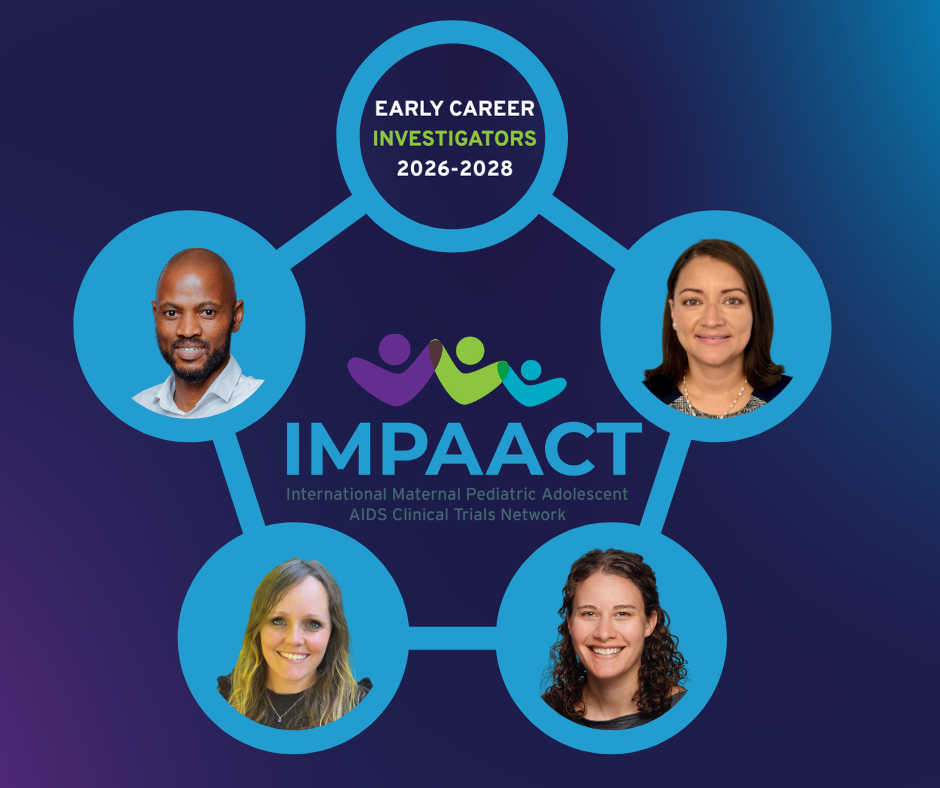
The IMPAACT Network is pleased to announce the recipients of the Early Career Investigators program. These four investigators will complete a project using data and samples generated by IMPAACT Network studies:
VIVIANNA FAJARDO-MARTINEZ, MD
University of California, Los Angeles - USA
Longitudinal Metabolomic Signatures of HIV and Other Perinatal Infectious Exposures: Biomarker Discovery for Early Neurodevelopmental Risk
SACHA HORN, PhD, MSc
University of Wisconsin, Madison - USA
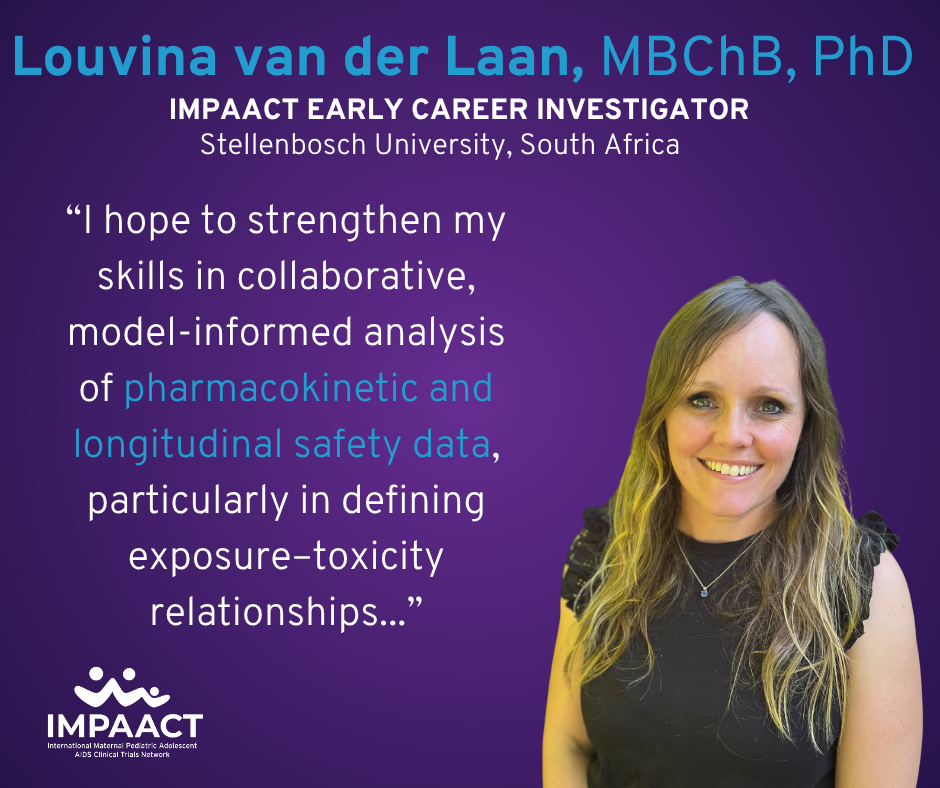
LOUVINA VAN DER LAAN, MD, PhD
Stellenbosch University - South Africa
Addressing Critical Evidence Gaps in Linezolid Dosing and Safety for Children with Rifampicin-Resistant Tuberculosis
PONEGO L. PONATSHEGO, MD, MSc
Botswana Harvard Health Partnership - Botswana
Evaluating Accelerated Epigenetic Aging and Associated Factors in Adolescents Living with HIV
Vivianna Fajardo-Martinez, MD
PROJECT
Longitudinal Metabolomic Signatures of HIV and Other Perinatal Infectious Exposures: Biomarker Discovery for Early Neurodevelopmental Risk
BIOGRAPHY
Viviana Fajardo-Martinez, MD, is an Assistant Professor of Pediatrics in the Division of Neonatology at the David Geffen School of Medicine at UCLA and an early-career physician-scientist. Her research focuses on understanding how maternal infections and inflammation during pregnancy influence infant health and neurodevelopment, with particular interest in the immune and metabolic pathways that contribute to vulnerability or resilience following prenatal exposures.
Dr. Fajardo-Martinez has been engaged in research since her undergraduate training in biological sciences, and scientific investigation has remained an integral part of her medical and academic career. Her research background spans basic and translational science, including postdoctoral training in developmental biology, cardiac development, metabolism, and regeneration. Together with her clinical training in neonatology, these experiences shaped her current interest in the maternal-fetal interface and in understanding how maternal immune activation can influence the developing infant.
In 2020, Dr. Fajardo-Martinez helped launch the COVID Outcomes Mother-Infant Pair (COMP) study at UCLA under the mentorship of Dr. Karin Nielsen and subsequently led its infant neurodevelopmental component. In this role, she integrated longitudinal developmental assessments with maternal and infant clinical and immunologic data from birth through early childhood. Through COMP and other perinatal infection cohorts, she has developed expertise in longitudinal maternal-infant research, biospecimen collection and management, immune profiling, and interdisciplinary team science.
Her current research leverages well-characterized maternal-infant cohorts, archived biospecimens, and detailed clinical and developmental data to investigate the biological consequences of maternal HIV and other infections. She is particularly interested in integrating immunologic profiling, metabolomics, and systems-level approaches to identify early biomarkers and define mechanisms linking maternal immune activation with infant outcomes. Her long-term goal is to develop a translational research program that advances early identification of infants at increased risk and informs targeted strategies to improve long-term health and developmental outcomes.
As a neonatologist, Dr. Fajardo-Martinez brings the perspective of caring for critically ill newborns and their families to her scientific work, grounding her research questions in clinically meaningful problems. She is also committed to education and mentorship and has mentored undergraduate students, pediatric residents and serves as a clinical mentor to neonatology fellows. Through collaborative, multidisciplinary research, she aims to bridge discoveries in maternal-infant immunology and metabolism with approaches that can ultimately improve outcomes for infants and children.
Sacha Horn, PhD, MSc & Louvina van der Laan, MD, PhD
PROJECT
Addressing Critical Evidence Gaps in Linezolid Dosing and Safety for Children with Rifampicin-Resistant Tuberculosis
BIOGRAPHIES
Sacha Horn, PhD, MSc is an epidemiologist and global health researcher whose work focuses on improving the evidence base for the prevention and treatment of pediatric tuberculosis in high-burden settings. She is a Research Scientist in the Department of Pediatrics and Division of Global Pediatrics at the University of Wisconsin-Madison, where she provides scientific, epidemiologic, statistical, and project management support for international pediatric tuberculosis research initiatives.
Dr. Horn's research combines epidemiologic methods, quantitative data analysis, and collaborative clinical research to address critical questions in child health. Her current work spans multinational clinical trials, observational studies, and consensus-building initiatives aimed at advancing the care of children affected by tuberculosis. She supports the coordination and implementation of international research projects, works closely with investigators and trial sites across multiple countries, and contributes to study design, data analysis, and interpretation of findings. Her research interests include treatment safety, optimization of pediatric tuberculosis therapies, clinical trial methodology, and the application of epidemiologic approaches to complex global health challenges.
Prior to joining the University of Wisconsin, Dr. Horn completed her PhD in Public Health and Epidemiology at Ludwig Maximilian University of Munich, where she conducted research on infectious diseases and population health in sub-Saharan Africa. She has also served as a statistical consultant, advising on study design, data analysis, and the communication of research findings.
Throughout her career, Dr. Horn has been committed to rigorous and reproducible research, with particular expertise in epidemiologic study design, longitudinal data analysis, and the use of statistical methods to answer clinically relevant questions. She enjoys working at the interface of methodology and applied research, helping transform complex data into evidence that can inform policy, clinical practice, and future research.
As a member of several international research collaborations, Dr. Horn is passionate about fostering cross-disciplinary partnerships and supporting research that improves health outcomes for children and families worldwide.
Louvina Elizabeth van der Laan, MD, PhD is a paediatric research clinician and pharmacometrician at the Desmond Tutu TB Centre, Department of Paediatrics and Child Health, Stellenbosch University, South Africa. She holds an MBChB and Diploma in Child Health, as well as an MPhil with distinction and a PhD in Clinical Pharmacology and Pharmacometrics from the University of Cape Town. Her work integrates paediatric clinical research with model-informed drug development to optimise medicines for children and other special populations, particularly those affected by tuberculosis (TB) and HIV in resource-limited settings.
Since joining the Desmond Tutu TB Centre in 2014, Dr van der Laan has combined paediatric clinical-trial responsibilities with pharmacometric research across TB and HIV studies involving participants from infancy through adolescence. She directly assesses trial participants, manages treatment-related adverse events, and oversees clinical safety assessment and adverse-event reporting in accordance with trial and regulatory requirements. Her work encompasses protocol development, study implementation, clinical oversight, population pharmacokinetic and pharmacodynamic modelling, simulation, interpretation, publication and the translation of research findings into practical dosing guidance.
She serves as Site Principal Investigator for IMPAACT P2034, which evaluates pretomanid in children, and IMPAACT P2005, which evaluates paediatric delamanid. She also served as a co-investigator for IMPAACT P1108, which evaluated the pharmacokinetics, safety and tolerability of bedaquiline in children with rifampicin-resistant TB. As Principal Investigator of the investigator-initiated PERFORM study, she led the programme from protocol development and clinical implementation through pharmacometric analysis and publication, evaluating the relative bioavailability, pharmacokinetics and acceptability of dispersible and non-dispersible levofloxacin formulations in young children.
Her broader clinical and pharmacometric experience includes linezolid, clofazimine, cycloserine/terizidone, para-aminosalicylic acid, rifapentine, high-dose isoniazid, first-line TB medicines and antiretroviral–TB drug interactions. She develops physiologically plausible population pharmacokinetic and exposure–response models and translates their findings into practical paediatric dosing, trial-design and formulation strategies. Her work has contributed to model-informed dose selection and the development of child-friendly formulations. She has published extensively in paediatric TB pharmacology and drug development and currently co-supervises PhD candidates in pharmacometrics and paediatric TB research.
Since 2022, the World Health Organization has appointed Dr van der Laan as a pharmacometrician and guideline and report writer supporting model-informed dosing for drug-susceptible TB, rifampicin-resistant TB and TB prevention. Her current work includes harmonising adult and paediatric doses across WHO weight bands. She serves on the WHO Technical Advisory Group for Tuberculosis and the core WHO CADO/PADO working group, which prioritises compounds and guides child-friendly formulation development.
In 2026, Dr van der Laan received an IMPAACT Network Early Career Investigator Program Award. Together with Dr Sacha Horn, she will use pharmacokinetic and longitudinal safety data from IMPAACT P1108 and P2005 to address critical evidence gaps in linezolid dosing and toxicity among children with rifampicin-resistant TB. The project aims to evaluate current paediatric doses, quantify exposure–toxicity relationships and identify children at increased risk of treatment-limiting adverse events, ultimately supporting safer, evidence-based linezolid dosing and monitoring strategies for children worldwide.

Ponego L. Ponatshego, MD, MSc
PROJECT
Evaluating Accelerated Epigenetic Aging and Associated Factors in Adolescents Living with HIV
BIOGRAPHY
Ponego L. Ponatshego, MD, MSc holds the position of CRS Leader (Molepolole, Site 12702) at the Botswana Harvard Health Partnership (BHP). He has worked on several IMPAACT studies, including IMPAACT 2017, for which the IMPAACT ECI award is based.
His primary research interest is in the consequences of aging with HIV in resource limited settings. Due to the rise in non-communicable diseases and other complications as people age on antiretroviral treatment (ART) the rise of non-communicable diseases among aging people living with HIV, strains fragile healthcare systems by shifting focus from infection control to lifelong multi-morbidity management. This transition triggers severe socioeconomic consequences, driving households into poverty through high out-of-pocket medical costs and lost income from chronic disability. At the national level, the trend lowers workforce productivity and exhausts social welfare systems, which many people depend on in these settings.
Recently, his interest has grown to include concepts such as intrinsic capacity, allostatic load and epigenetic aging. Intrinsic capacity, allostatic load, and epigenetic aging directly dictate how your body physically ages by driving the transition from cellular stress to structural and functional decline.
Epigenetic aging deviations have been shown to consistently predict morbidity, mortality and other aging-related outcomes. HIV infection causes accelerated biological aging at the molecular level, meaning a person's cells and DNA show signs of being older than their actual calendar age. Studies show that children, adolescents, and young adults living with HIV, exhibit epigenetic age acceleration compared to their peers without HIV. This has the potential to disrupts critical windows of childhood growth, brain development, and immune system maturation.
With the IMPAACT ECI award granting access to IMPAACT 2017 (MOCHA) trial samples and data, providing advanced bioinformatics mentorship and global research visibility, he is excited to implement this project, which will use DNA methylation-based epigenetic clocks, to estimate biological age and quantify epigenetic age acceleration among adolescent participants and compare epigenetic age with chronological age; examine associations between epigenetic age and clinical, HIV treatment-related, and sociodemographic factors, as well as assess regional differences across participating countries.